Everything is made of chemicals, but sometimes, it is necessary to separate one chemical from another—for instance, to purify metal ores, to clean up contaminated wastes, even to combat disease.
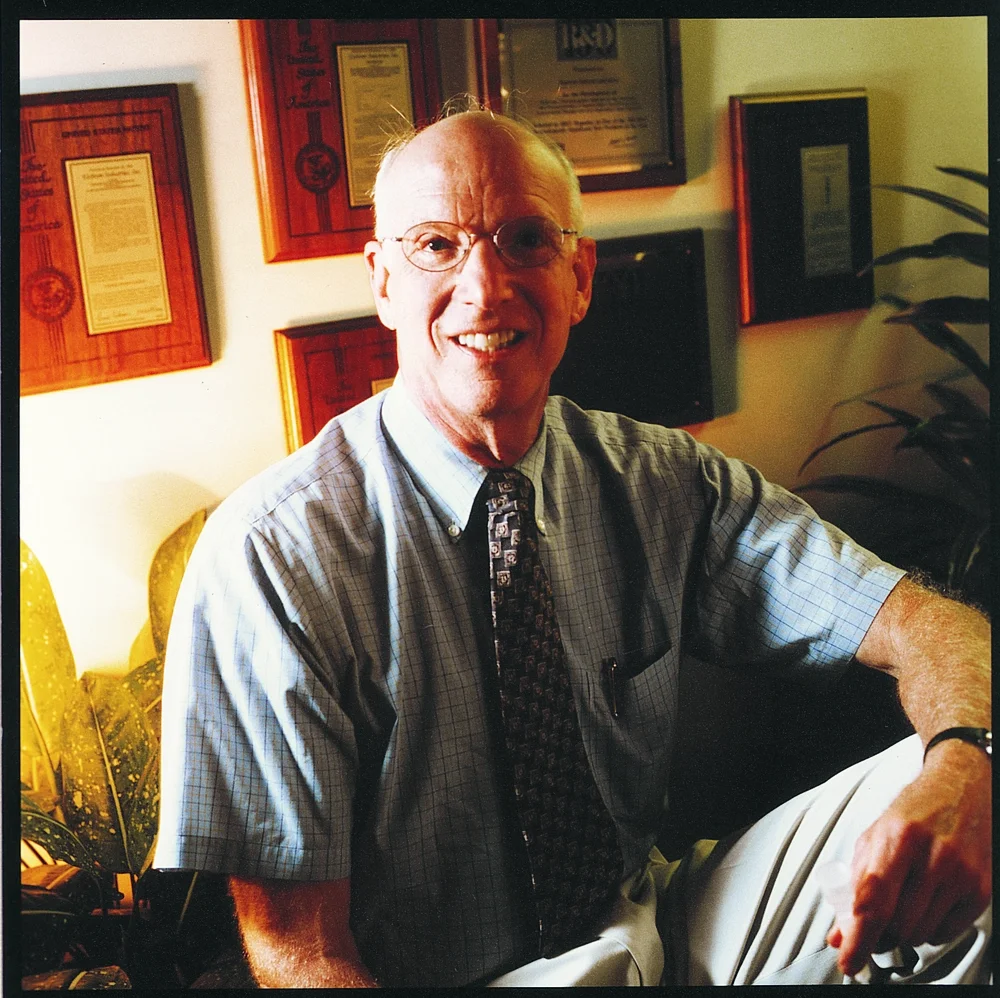
One of this year's College of LAS Achievement Award winners, E. Philip Horwitz (MS, '55; PhD, '57, chemistry), is a master of such "chemical separations" technology: he has developed a number of chemical separations technologies that are applicable to a host of conditions. Horwitz's techniques have been used to separate and purify isotopes used by NASA to analyze the elemental content of the moon's surface. His techniques for separating and purifying the multiple "daughter" isotopes from the decay of uranium and thorium isotopes may one day be used in treating various types of cancer.
One of Horwitz's greatest accomplishments was developing the TRUEX and SREX processes that recover toxic radioactive elements from the "chemical soup" of high-level radioactive wastes. These new processes were adapted to laboratory-scale chromatographic techniques that are now used worldwide for the determination of radionuclides in environmental and bioassay (e.g., urine) samples. As a result, a new company, Eichrom Industries, Inc., was founded in February 1990 to manufacture and market the new chromatographic resin. The above contribution is socially significant because it enables societies to more readily and cheaply monitor the environment for nuclear contamination and fallout.
After graduating from the University of Illinois in 1957 with both a master's and a PhD in chemistry, Horwitz worked for Dow Chemical Company in Midland, MI. Two years later, he began a 38-year association with Argonne National Laboratory, where he built one of the most successful chemical separations programs in the world. After leaving Argonne Labs in 1998, he founded PG Research Foundation and currently serves as its director.
Over the past 44 years, Horwitz has accumulated 36 patents and 11 awards for outstanding accomplishments in science.
To his colleagues, Horwitz is a living legend, both as a creative chemist and an inspiring educator. Professor Richard Reba, from the University of Chicago, calls him a man of vision with a probing intellect. He is a leader with the foresight and brilliance to transcend the traditional boundaries of science, technology and medicine.


